There are two ways a personal notes system dies. It explodes — folders, tags, backlinks, a graph, every feature asking a question before a note is allowed to exist. Or it implodes — you text yourself, zero features, and the thought lands instantly in a place you'll never look again. I've killed systems both ways. Minote, the app I ended up building, is a bet that the balance between the two isn't where I thought it was.
Power at the wrong end
I went the maximal route first. My last serious system parsed everything I saved into a knowledge graph — entities, links, clustered communities. Superpowered on paper, and all of the power sat at the wrong end of the pipe. Every capture opened with questions: where does this live, what is it called, what does it connect to. A running thought expires in the 1–2s it takes to answer even one of them. What survived the filing was immaculate — and untouched. Inputs, never outputs. The organization had become the product, and the product wasn't notes.
A chat with nobody
So I collapsed to the opposite extreme: I messaged myself. A chat thread is the fastest capture surface ever shipped — one field, one send, no filing, and the muscle memory already exists. But zero features has its own death. Saves bury saves; a link from March is forty flicks up; search knows my words but not what the photo or the page said. And the whole thing lives inside a messenger — behind a contact of myself I had to maintain, next to every conversation engineered to pull me somewhere else. Capture solved, retrieval abandoned: the same graveyard, with faster burials.
Implode the capture
Minote keeps the implosion — but only on the way in. Every capture is the same gesture: type, send, done. No folder, no title, no tag; photos and links arrive through the system share sheet with the same zero questions. Structure appears after the fact, from time alone — day dividers, a date header that follows the scroll. The capture side of the app is finished precisely because there is nothing left to remove.
Explode the retrieval
Every feature the capture side refused went to the other end. The bottom bar inverts the chat grammar: search is the long element and compose is a small circle beside it, because in a personal archive you retrieve more than you create. One bar holds both roles, and switching between them is free:
Tap the pill and it melts into a search field; tap the circle and it grows into a composer. Underneath, every note indexes itself on device — a link archives the page's og:description, a photo runs OCR and image labels the moment it lands — and the ranking stays legible: a match in your own words scores 3, a match in derived text scores 2, recency breaks ties. Found notes accept replies, replies form threads, and a swipe opens a sidebar that lists threads as units, so a topic survives being buried by newer saves.
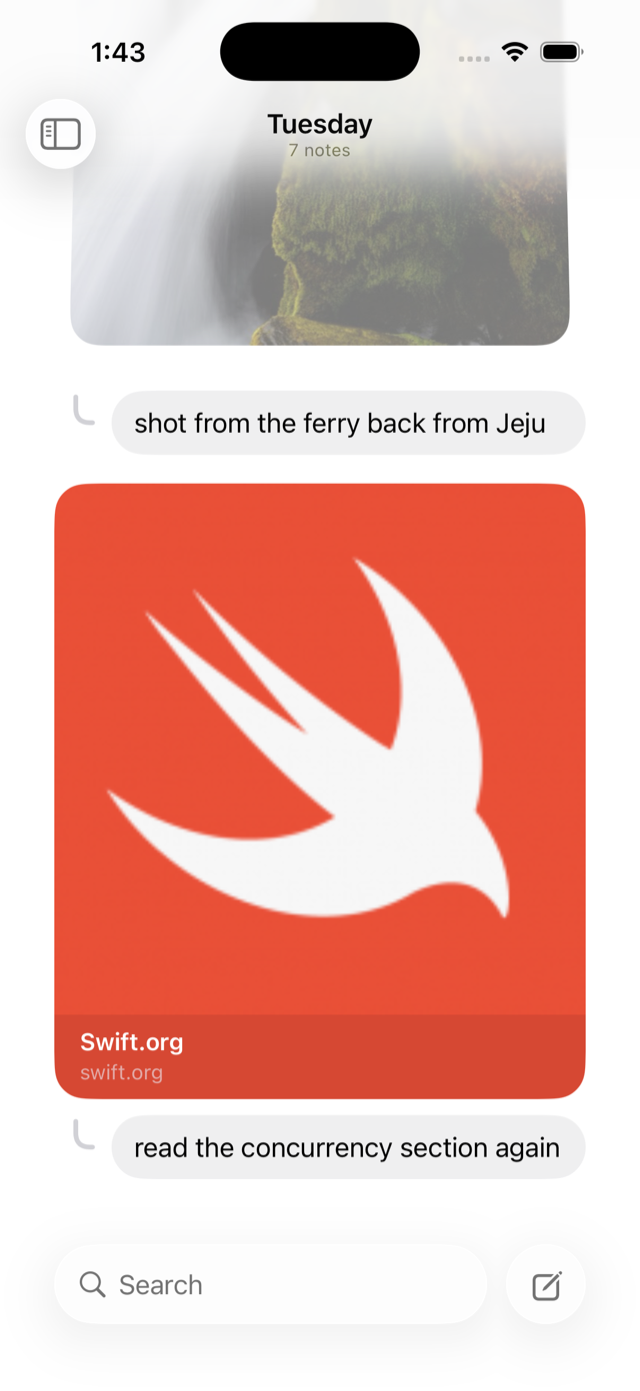
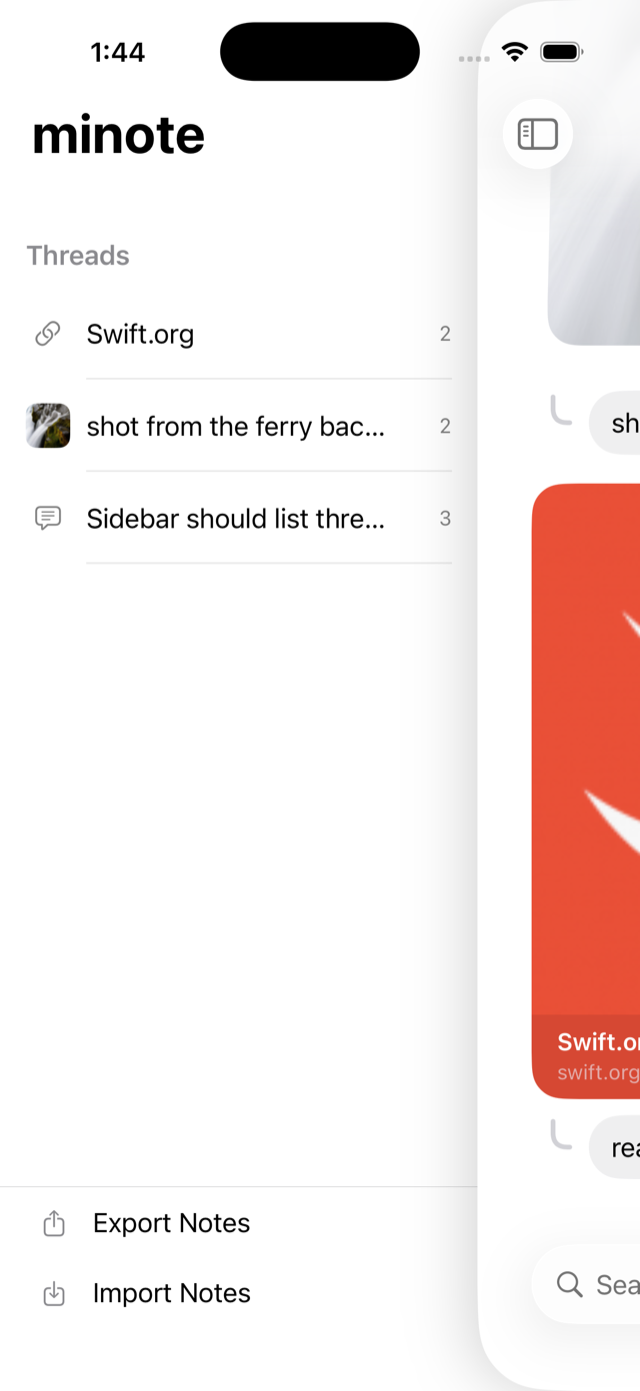
The real thing: the feed (capture) and the threads sidebar (retrieval).
The balance between explosion and implosion turned out not to be a midpoint. It's an asymmetry: a notes system should implode at the exact moment a thought arrives, and explode at the exact moment you reach back for one. Spend nothing on the way in. Spend everything on the way back.